Paleoanthropologist Cody Prang finds clues to our past in the foot of an ancient hominin.
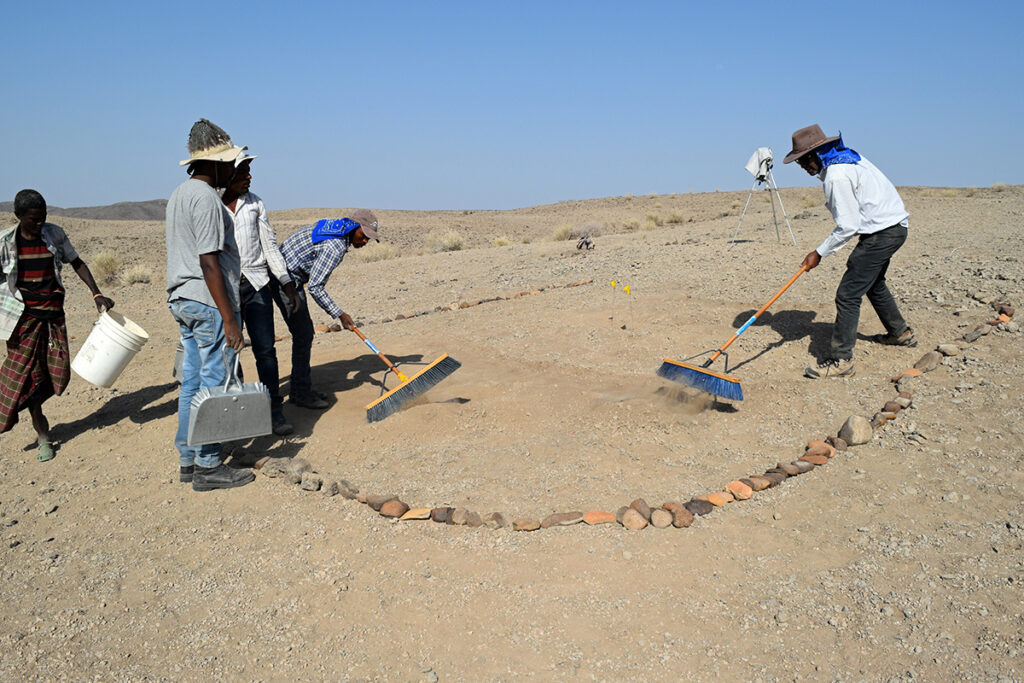
Sifting through the seemingly endless sands of Ethiopia’s Afar Rift, researchers have uncovered telling remnants of a long-lost human ancestor. As reported in Nature, tooth, jaw, and foot fossils discovered at the site can now be linked to Australopithecus deyiremeda, an ancient relative that had a taste for fruit and a penchant for climbing trees. The hominin lived some 3.4 million years ago, a pivotal point in the evolutionary branch that would eventually lead to Homo sapiens.

Australopithecus deyiremeda shared the landscape with Australopithecus afarensis, the hominin species made famous by the Lucy fossil. Even though Lucy has far more acclaim, it’s likely that Australopithecus deyiremeda is a closer human relative, said Thomas “Cody” Prang, an assistant professor of anthropology who analyzed the foot structure of the species. “This species is another reminder that human evolution is more diverse than once thought,” he said.
The lead author of the study is Yohannes Haile-Selassie of Arizona State University. Funding for this project was provided by the National Science Foundation and the W.M. Keck Foundation.
Haile-Selassie and his team first uncovered the foot fragments in 2009. The shape of the toe immediately suggested that the foot — known as the Burtele foot — didn’t come from a member of A. afarensis, but the researchers couldn’t confidently assign a species based on the foot alone. Jaw bones and teeth are usually necessary to recognize a species, Haile-Selassie explained.