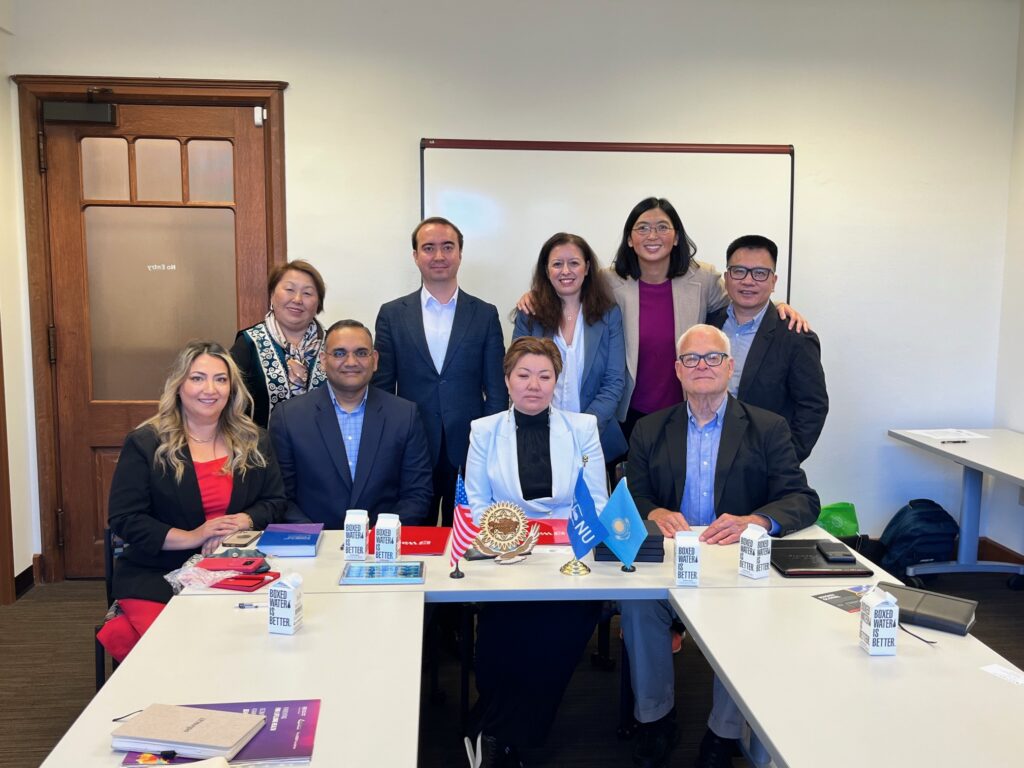
We provide guidance and support to the WashU community when they seek to establish new international partnerships.
The resources on these pages define international agreement types, provide direction for initiating and renewing agreements, offer best practices, and answer frequently asked questions.
WashU often formalizes partnerships through various types of agreements, depending on the objective.
Planning an international agreement?
For any international agreement, new or continuing, please reach out to WashU Global as you explore this content.
Formalizing a partnership
To begin the process of formalizing a partnership, start by reviewing the guidance and follow the steps outlined for each agreement type.
Often, partnerships are first formalized in a Memorandum of Understanding (MOU). The parties may later formalize their partnership further with detailed legal agreements about specific activities.
An MOU is an explicitly non-binding document that contemplates collaborative activities and general statements of mutual interest to explore new opportunities for collaboration. MOUs may be institution-wide or specific to your department or unit at WashU.
MOUs do not include commitments of university funds, staff, facilities or other university resources. The MOU may serve as the first step in developing future agreements which are advanced through different processes (e.g., grant subawards, procurement agreements, data sharing agreement, dual degree programs, etc.).
Although an MOU is not required, international partners may request one to initiate a partnership. WashU is happy to engage these requests.
For ceremonial, non-binding MOUs, follow the review process.
Unlike an MOU, a legal agreement is a binding contract that details the terms and conditions of specific forms of partnership and requires review by a variety of stakeholders at WashU. A legal agreement includes terms that purport to bind WashU to commitment of resources, specific measurable effort of faculty or WashU staff, space, or detailed statements of work.
Below are some examples of terms and conditions that may be included in a legal agreement:
- Pricing or payment terms;
- Deliverables required, including technical reports;
- A specific scope of work is included;
- Intellectual property ownership or licensing terms;
- Publication limitations;
- Confidentiality terms that infer a sharing of proprietary, human subjects, or other sensitive data;
- Commitment of resources such as facilities, equipment, personnel, or students.
The Joint Research Office for Contracts (JROC) oversees the process for research agreements, including those listed below. For more information, contact researchcontracts@wusm.washu.edu.
- Collaboration agreements (around a specific research proposal/project, with a defined scope for collaboration)
- Clinical Trial Agreements
- Confidentiality Agreements
- Data Transfer Agreements
- Incoming Subawards
The Office of Sponsored Research Services (OSRS) oversees the process for outgoing subawards. For more information, contact researchgrants@wusm.wustl.edu
How to initiate each type of agreement
All international agreement types outlined below require review by the Senior Vice Provost for Graduate Education and International Affairs (VPGEIA) prior to signing.
For questions regarding international agreements, contact global@wustl.edu.
For international agreement types outlined below within the School of Medicine, please first consult Caline Mattar, Director of Global Health Education and Partnerships.
For information on other categories of legal agreements, please consult the Omnibus Delegation of Signature Authority.
Agreement types
MOU
Scope: Ceremonial, non-binding
Point of Contact: WashU Global
Review Process: Follow steps outlined in Agreements Process. Use the approved MOU Template.
Authorized Signatory: VPGEIA*, School Deans
MOU Addendum/
Amendment
Scope: For renewal or amendment of original terms
Point of Contact: WashU Global
Review Process: Follow steps outlined in Agreements Process.
Authorized Signatory: VPGEIA, School Deans
Student Exchange/ Study Abroad or Faculty Exchange Agreements
Scope: Involving student or faculty exchange to engage in coursework, research and/or teaching at WashU or the partner institution, e.g., study abroad programs**
Point of Contact: Start at school deans-level.
Review Process: Initial review by a school dean, then follow steps outlined in the Agreements Process.
Authorized Signatory: VPGEIA*, School Deans
Academic Cooperation Agreement
Scope: To accomplish multiple objectives: student and faculty exchanges and joint research activities, etc.
Point of Contact: WashU Global.
Best practice: It is generally preferable to develop separate agreements for each objective.
Review Process: Follow steps outlined in Agreements Process.
Authorized Signatory: VPGEIA*, School Deans
Dual/Joint Degree Program Agreement
Scope: Joint/dual degree programs involving international partner
Point of Contact: WashU Global
Review Process: Follow the Provost Office’s Proposal for New Credentials and Modifications process and review the Template for International Agreements.
Authorized Signatory: Provost, VPGEIA
*In some instances, the Provost or the Chancellor is the appropriate signatory.
** When hosting a visiting researcher at WashU, consult Guidance for Hosting International Visiting Researchers
Partnership proposal form
For use by WashU faculty and administrators only
To propose a new international partnership agreement to be formalized, please complete the Partnership Proposal Form.
Fully executed agreements
Every department is required to submit the fully executed international agreements to this central repository. After an agreement is signed by both partners, please upload it into the WashU Global Database using the Fully Executed Agreement Form.
WashU Global administers the institution’s central repository for all fully executed international agreements.
If your department has fully executed international agreements that do not currently appear in the database, please use the Fully Executed Agreement Form to upload them. You can access the database for fully executed international agreements/MOUs by clicking the Search Database button.
Commonly asked questions
- Is there an approved template for an international MOU?
-
Yes, this template is approved for use for ceremonial, non-binding MOUs. Using the WashU template helps expedite the review process.
- Who at WashU needs to be consulted prior to signing an international agreement?
-
Any international agreement of the type outlined here must be reviewed and signed by the Senior Vice Provost for Graduate Education and International Affairs. Through WashU Global’s international agreements review process, the appropriate entities will be consulted based on the agreement type. This may include, but is not limited to, the Office of General Counsel, School Deans, University Registrar and the Office of the Vice Chancellor for Research.
- Who is the appropriate contact for questions about research-related international agreements such as subawards or data transfer agreements?
-
For International Research Agreements, contact JROC.
- How long does the internal review process typically take for initiating or renewing international agreements/MOUs?
-
Typically, the review process takes 2-4 weeks. To help expedite review, please follow the agreements process and utilize WashU templates.
- What should I do with active international agreements/MOUs from prior years that are missing from the WashU Global Database?
-
Please use the Fully Executed Agreement Form to upload active international agreements/MOUs, signed by both WashU and the partner institution.
- If an agreement requires additional review by other entities on campus, who can direct me to the appropriate contacts?
-
WashU Global will guide you through the process to help ensure a thorough and timely review.
- Who is authorized to sign MOUs/international agreements?
-
All MOUs/international agreements of the type outlined here must be signed by the Senior Vice Provost for Graduate Education and International Affairs, Vijay Ramani, and (for agreements limited in scope to a single school) a school dean, following the completion of the review/approval process.